Table of contents
Forestry operations rely heavily on efficient equipment to manage vegetation, maintain landscapes, and clear land. Mulchers and chippers stand out for their adaptability and ability to handle a wide range of tasks in both commercial and conservation settings. Uncover how these machines transform forestry work and why their role continues to grow in significance throughout the industry.
Understanding mulchers and chippers
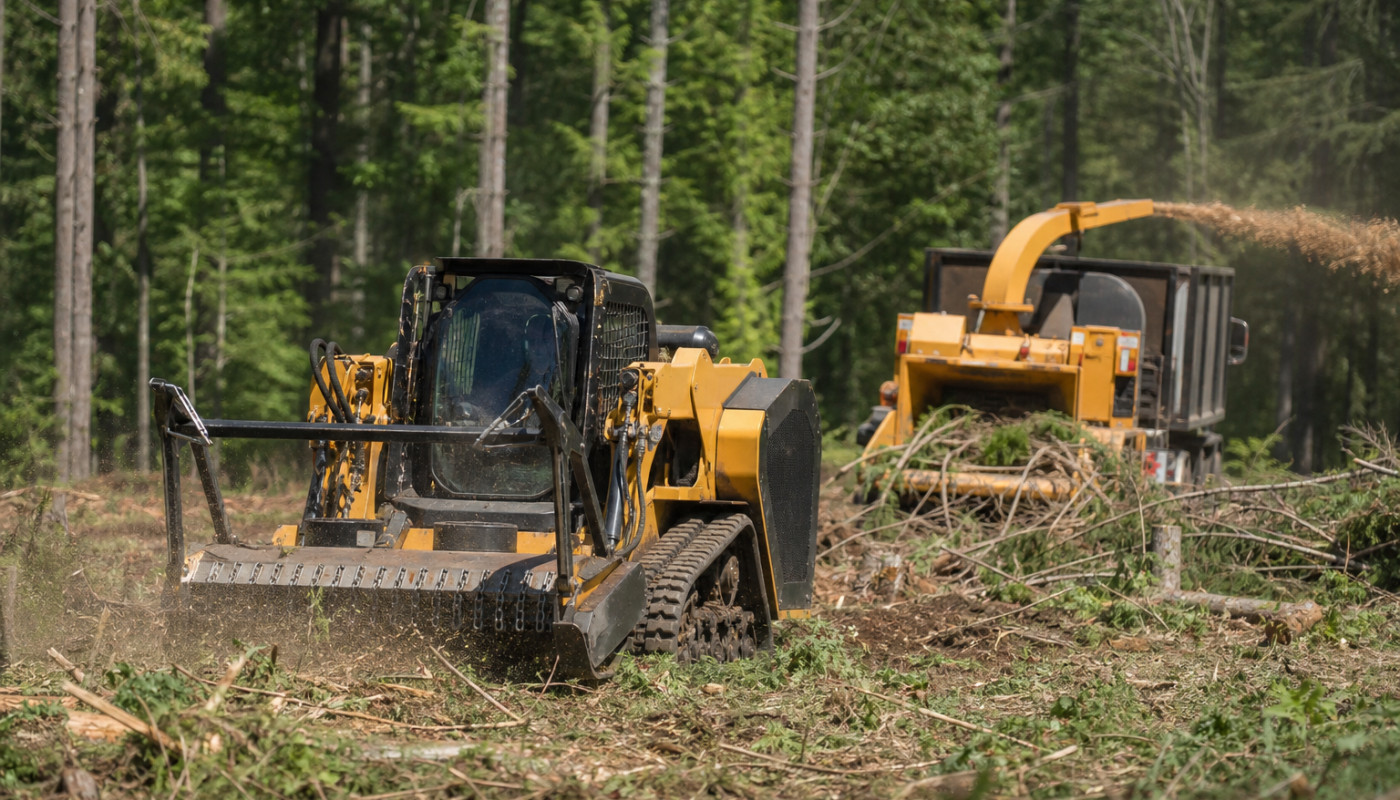
Forestry machinery plays a significant role in efficient land clearing and vegetation management, with wood mulchers and chipper machines standing out as two widely used types of land clearing equipment. While both tools help process organic material, their working principles and outputs differ considerably. A wood mulcher is designed to grind and shred underbrush, saplings, and smaller branches into a fine, nutrient-rich mulch, making it highly suitable for soil improvement, erosion control, and quick decomposition. The core component, often a rotor drum equipped with multiple teeth or blades, spins at high speed to pulverize vegetation on contact, enabling even distribution of mulch across the cleared area.
Chipper machines, on the other hand, are specialized for converting larger branches, logs, and woody debris into uniform wood chips. As the material is fed into the chipper, it encounters sharp blades or a disk mechanism that slices it into chips ideal for biofuel, landscaping, or transport. This process not only reduces bulk but also creates a valuable byproduct for various applications in forestry and agriculture. The key distinction lies in the end product: mulchers create a finer mulch suitable for spreading, while chippers yield coarser chips better suited for energy production or ground cover.
Choosing between a wood mulcher and a chipper machine depends largely on the specific needs of a forestry project. For tasks requiring rapid reduction of dense, low-lying vegetation and the creation of mulch for reintroduction into the ecosystem, mulchers are optimal. When the primary challenge is the disposal or repurposing of thicker branches and logs, chippers excel. Both machines are integral to vegetation management, offering unique benefits for land clearing operations, and can often be found working together on larger forestry sites to maximize efficiency and resource utilization.
Forestry engineers are continually refining these machines, integrating advanced rotor drum technologies and enhanced safety features to suit diverse environmental conditions and operational requirements. For those seeking detailed specifications, operational guides, or custom solutions, the site offers a comprehensive overview of modern forestry machinery, including wood mulcher and chipper machine options tailored for various forestry tasks. This resource can help both professionals and landowners make informed decisions about the best land clearing equipment for their needs.
Applications in land clearing
Mulchers and chippers are integral forestry equipment in brush clearing and land preparation projects, serving both agricultural and development purposes. Their mechanical power enables rapid removal of overgrown vegetation, small trees, and thick underbrush that would otherwise be labor-intensive to clear by hand. In practice, these machines utilize a feed chute to efficiently process large volumes of organic material, breaking it down through the mulching process into manageable chips or mulch that can be repurposed for soil enrichment or erosion control. For fire prevention, reducing combustible material is a key strategy, and mulchers and chippers help create defensible spaces around properties and infrastructure by eliminating fuel sources. A top forestry project manager should detail how this equipment is deployed in phased land clearing operations, from initial access routes through to final site cleanup, showcasing their adaptability in a range of terrains and project scales.
Environmental considerations
Utilizing mulchers and chippers in sustainable forestry presents significant ecological advantages, notably through biomass recycling and soil enrichment. These machines facilitate the conversion of forestry debris into mulch or chips, which can be redistributed across the landscape to enhance organic matter, improve water retention, and contribute to natural carbon sequestration. By reducing the need for burning or transporting waste, mulchers and chippers promote eco-friendly practices and lower overall emissions. In addition, the application of mulch helps prevent soil erosion and supports long-term soil fertility, which is a foundational element for productive ecosystems.
While these tools offer several environmental benefits, challenges remain regarding habitat protection and the potential disruption of wildlife. Improper or excessive use may disturb habitats, threaten biodiversity, and hinder the growth of native species. Sustainable forestry requires balancing operational efficiency with ecological responsibility, ensuring that machinery is employed with careful planning and minimal ecological disturbance. The leading environmental forestry consultant emphasizes the necessity of developing site-specific strategies that account for local flora and fauna, optimize biomass recycling, and prioritize the health of forest soils. Integrating these practices ensures that forestry operations not only maximize their immediate yield but also protect environmental integrity for future generations.
Safety and operational efficiency
Forestry safety hinges on rigorous operator training and diligent equipment maintenance, with effective strategies reducing workplace hazards when handling mulchers and chippers. Comprehensive operator training should cover not only machine controls but also the identification of site-specific risks, safe machine entry and exit, and the immediate use of the emergency stop mechanism in unexpected situations. Workplace hazards, such as flying debris, entanglement risks, or noise exposure, require operators to use personal protective gear and adhere to established safety zones around active equipment. Routine equipment maintenance, including checking blades, hydraulic systems, and safety shields, prevents malfunctions that could otherwise compromise efficient operations. Insights from the head safety officer in forestry equipment operations highlight the significance of pre-shift inspections, clear communication protocols, and regular drills involving the emergency stop mechanism to equip teams for rapid response, further ensuring that operational efficiency never comes at the expense of safety.
Efficient operations are not solely a product of advanced machinery; they depend on a culture of safety reinforced by ongoing training and proactive equipment checks. Operator training programs must be updated to reflect new technology and changing workplace hazards, emphasizing practical skills and hazard recognition. Proper equipment maintenance reduces downtime and extends the lifespan of both mulchers and chippers, contributing to more productive forestry activities. The head safety officer advises integrating digital monitoring systems for maintenance scheduling and incident tracking, ensuring that any irregularities are swiftly addressed. By fostering an environment where forestry safety and efficient operations go hand in hand, the risks associated with mulchers and chippers are minimized, resulting in smoother workflows and safer worksites.
Future trends in forestry machinery
Forestry technology is advancing rapidly, driven by machinery innovation that is reshaping how mulchers and chippers are designed and operated. Emerging trends include the development of automated mulcher units capable of performing complex tasks with minimal human intervention, which not only increases safety but also boosts productivity. Remote monitoring is becoming a standard feature, allowing operators and managers to oversee real-time performance, fuel usage, and maintenance needs from a centralized location. This capability often relies on sophisticated telematics systems, which collect and transmit operational data for analysis and optimization. Fuel-efficient designs are also at the forefront, as manufacturers seek to minimize environmental impact and operating costs, making equipment upgrades more attractive to forestry professionals.
The chief innovation officer in forestry machinery must anticipate how these advancements will redefine forestry operations in the coming years. Increased adoption of automated and remotely managed equipment will likely lead to improved efficiency and reduced labor requirements, while telematics-enabled machinery will facilitate predictive maintenance and smarter resource allocation. This evolving landscape emphasizes the shift toward data-driven decision-making, with automated mulchers and intelligent chippers setting new benchmarks for performance and sustainability. As forestry technology continues to advance, equipment upgrades will become integral to staying competitive and ensuring long-term operational success.
Similar


